
Building Trust Into Titling | A Conversation with Marcy Coleman of AAMVA
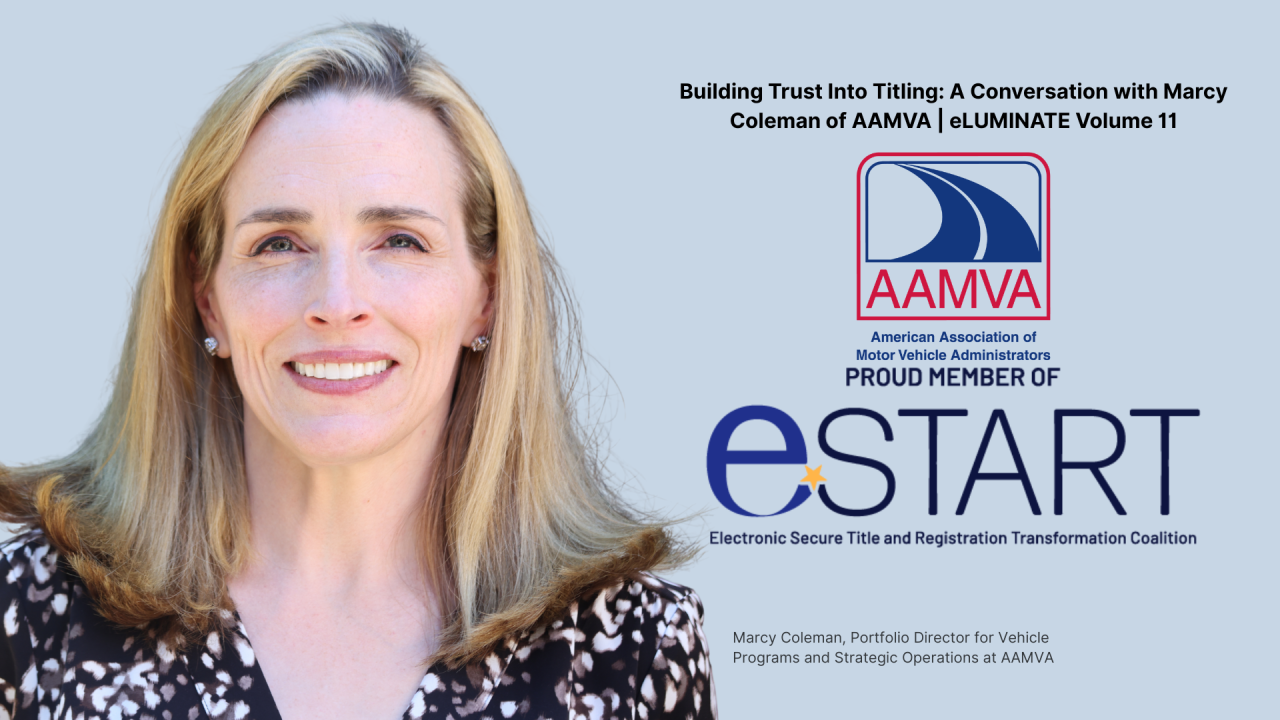
For part 11 of eLUMINATE: An eSTART Coalition Profile Series, we sat down with Marcy Coleman, Portfolio Director for Vehicle Programs and Strategic Operations at AAMVA (American Association of Motor Vehicle Administrators).
In this conversation, Marcy talks about her work at the crossroads of policy, operations, and data, why vehicle titling and registration matter far beyond paperwork, and how collaboration and alignment – not just technology – are essential to modernization efforts that work across 51 different jurisdictions with 51 different laws and systems.
Let’s start with introductions – tell us a little bit about yourself?
My name is Marcy Coleman, and I serve as Portfolio Director for Vehicle Programs and Strategic Operations at the American Association of Motor Vehicle Administrators (AAMVA). At a high level, my role sits at the intersection of policy, operations, and data. I work with our jurisdictional members, industry partners, and federal and state stakeholders to ensure that the systems behind vehicle titling, registration, and identification are not only modern and secure but also practical and sustainable for the people who run them every day.
A lot of my work centers on standards – how states share and verify vehicle information, how systems communicate with one another, and how we create national frameworks that enable innovation without undermining the legal and operational foundations that keep the system trustworthy.
Can you tell me more about AAMVA?
AAMVA is a nonprofit organization that supports state and provincial motor vehicle agencies across the United States and Canada. Our members are the agencies that issue driver licenses, register vehicles, and manage titles – the organizations responsible for some of the most foundational identity and vehicle data in North America.
We serve as a standards body, as well as a technical and policy resource. We help states collaborate on shared systems, develop best practices, and speak with a collective voice on issues that affect the vehicle and driver ecosystem.
What was your journey to get to AAMVA like?
My path here wasn’t a straight line, but it was always rooted in systems and problem-solving. I’ve spent much of my career working at the point where policy meets operations – where a legislative idea or a technology solution has to become something real that people can use and administer.
What drew me to AAMVA, and what’s kept me here, is the complexity of the vehicle and driver space. It’s one of those areas that most people only think about when something goes wrong – when a title is delayed, a registration can’t be verified, or a transaction stalls. But behind the scenes, there’s an incredibly intricate web of legal requirements, data exchanges, and operational processes that have to work together seamlessly.
Being part of an organization that helps shape that ecosystem at a national level – while still staying grounded in the day-to-day realities of state agencies—has been both challenging and rewarding.
Why does titling and registration matter to you?
Titles and registrations are often seen as administrative paperwork, but in reality, they are legal, financial, and public safety instruments all at once. A title represents ownership, liability, and value. A registration ties a vehicle to a jurisdiction, a set of laws, and a system of accountability.
What made me care about this space was seeing how many different stakeholders rely on the same core data: consumers, dealers, lenders, law enforcement, courts, insurers, transportation agencies, and policymakers. When that system works, transactions are smooth, trust is high, and risks are low. When it doesn’t, the impacts ripple far beyond a single DMV counter or online portal.
That’s what keeps me invested in modernization efforts – not just making things faster or more digital, but making them stronger, more reliable, and more connected.
Why the involvement with eSTART?
For us, eSTART represents an important part of the broader ecosystem working toward modernization in a thoughtful way. It’s a space where conversations can happen across traditional boundaries – between public agencies and private industry, between policy leaders and technical experts.
What I value most is the emphasis on understanding the full lifecycle of a title and registration transaction. It’s not just about the moment a title becomes electronic; it’s about how that data is created, validated, transferred, stored, and ultimately relied upon by multiple parties over time.
That systems-level thinking is essential if we want electronic titling to be durable, not just innovative.
What do you think is the biggest barrier to modernizing titling and registration?
The biggest barrier to modernization isn’t necessarily just technology – it’s also alignment.
We operate in a space where every jurisdiction has its own laws, processes, and legacy systems. Titles and registrations are governed by state statutes, court rulings, and long-standing administrative practices. Even when two states want the same outcome, the path to get there can look very different.
So when we talk about modernization—especially something as foundational as electronic titling—we’re really talking about synchronizing legal frameworks, operational workflows, and technical standards at the same time. That’s complex work, and it takes patience, trust, and sustained collaboration.
Another challenge is that modernization often competes with daily operational demands. State agencies are focused, first and foremost, on serving customers, processing transactions, and keeping systems running. Finding the time and resources to redesign those systems while they’re actively in use is no small task.
What do you think people miss in conversations about eTitling and registration?
I think what’s most underappreciated is the role of data governance.
It’s easy to focus on the front-end experience – the digital form, the electronic signature, the online portal. But behind every one of those touchpoints is a complex data ecosystem that determines whether the information is accurate, trusted, and usable by everyone who depends on it.
A title record isn’t just for the vehicle owner. It’s for lenders securing assets, law enforcement verifying legitimacy, courts resolving disputes, and other states validating cross-border transactions. If the underlying data standards, validation rules, and security frameworks aren’t aligned, digitizing the process can actually exacerbate problems rather than solve them.
That’s why AAMVA puts so much emphasis on national standards and verification systems. Modernization isn’t just about moving from paper to pixels – it’s about building a shared foundation of trust that every stakeholder can rely on.
Any last thoughts?
One of the things that matters most to me in this work is reframing how people think about vehicle administration. Titles and registrations aren’t just DMV functions – they’re part of the national infrastructure.
For me, success in modernization isn’t measured by how quickly we deploy a new tool. It’s measured by whether that tool still works ten or twenty years from now – across jurisdictions, across technologies, and across policy changes.
If we can keep that long-term perspective, and continue to bring public agencies and private partners together around shared standards and shared goals, I believe we can build a titling and registration ecosystem that is not only more efficient, but more resilient, more secure, and more worthy of the trust people place in it every day.
