
Turning Complexity Into Infrastructure | A Conversation with Tyler Raugh of Fairway
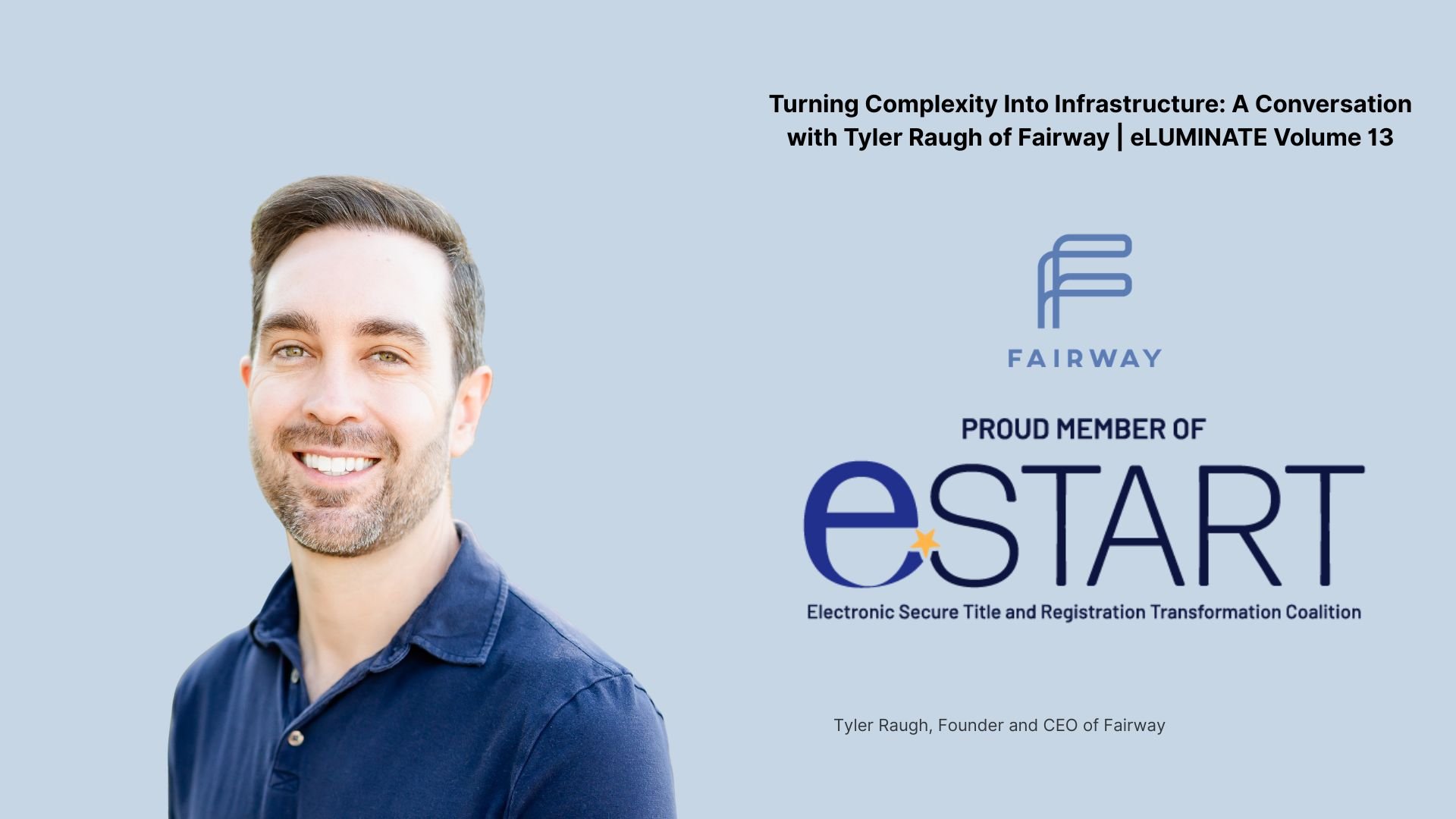
For volume 13 of eLUMINATE: An eSTART Coalition Profile Series, we sat down with Tyler Raugh, Co-Founder and CEO of Fairway. Tyler’s perspective is grounded in operations. He has lived the reality of title and registration complexity at scale, and he now leads a company focused on turning that complexity into reliable, repeatable systems.
In this conversation, Tyler shares why title and registration is core infrastructure, what truly slows modernization, and why durable progress depends on aligning the ecosystem around practical outcomes.
Can you introduce yourself and tell us a little about Fairway?
I'm Tyler Raugh, Founder and CEO of Fairway. My role is to stay close to the real operational pain in vehicle title and registration: where transactions stall, where applications get rejected, and where teams are forced to rely on tribal knowledge to get compliant work done. I spend my time translating those problems into product direction, customer insight, and a clearer view of what modernization has to solve in practice.
Fairway codified the rules and regulations that govern title and registration across jurisdictions, then built software on top of that foundation to power automated audits, transaction-specific checklists, and form filling. The goal is simple: make complex transactions easier to process accurately and compliantly for jurisdictions, dealers, fleets, tag agents, auctions, and other operators in the ecosystem.
The complexity is staggering. Across 50 states, roughly 3,000 counties, and the many combinations of transaction type, vehicle type, and other variables, there are over a billion rule permutations that can affect how a title and registration transaction should be processed. Today, too much of that complexity still lives in a person's head. We are building software so that knowledge can be codified, applied consistently, and carried forward from one step of the process to the next.
What brought you to this space?
Fairway's origin story really started with firsthand exposure to the problem. About ten years ago, I founded Booster Fuels and grew our fleet to more than 200 hazmat tankers. Operating that fleet meant dealing constantly with title and registration: paperwork, delays, manual follow-up, inconsistent requirements, and very few tools built for the people doing the work.
Once you operate vehicles at scale, you realize title and registration is not a back-office detail. It is core infrastructure. It determines whether an asset can be sold, financed, put into service, or transferred. When the process breaks, inventory sits, capital gets tied up, customers wait longer, and government staff spend time resolving issues that often could have been prevented upstream.
What pulled me deeper into the space was seeing how widespread and repeatable the problem was. Whether you were looking at fleets, dealers, lenders, service providers, or DMV teams, the same pattern showed up: too much depended on individual expertise and too little was carried by systems. That is why I care about modernization in a practical sense. It is about making the process more dependable for everyone who relies on it.
What is most often missed or underappreciated about this work?
Compliance logic is the product.
The hard part is not just putting a workflow on a screen. The hard part is correctly encoding the rules, dependencies, exceptions, and document requirements that determine whether a transaction can actually move forward.
A good example is a complex vehicle transaction where a vehicle is repossessed, auctioned, sold to a dealer, and then ultimately titled at the DMV. It is not unusual for more than 10 title clerks across different organizations to touch that transaction, analyze the requirements, and apply judgment to get it titled compliantly. That is a huge amount of duplicated effort and discretion in a process that should be far more consistent. We built Fairway for exactly that problem: to certify requirements, audit them at each handoff, and make the whole chain more accurate, more consistent, and far more automatable.
What do you see as the biggest barrier to modernization?
The biggest barrier is fragmentation. Every state has its own rules, documents, workflows, and implementation constraints, and in many cases there is meaningful variation beyond the state level. Modernization is hard not because the industry lacks interest, but because the complexity is real and the consequences of getting it wrong are real.
In the short term, fragmentation shows up as rejections, delays, manual exception handling, and heavy reliance on experienced staff to interpret requirements on the fly. In many states, we see critical errors in 20 to 30 percent of application submissions because requirements are missed, paperwork is assembled incorrectly, or jurisdiction-specific rules are applied inconsistently. In the long term, fragmentation slows interoperability because every organization is repeatedly translating the same rules for itself instead of working from shared operational infrastructure.
How did you get involved with eSTART, and what does it mean to Fairway?
I got involved with eSTART because it is one of the few groups bringing together the stakeholders who actually have to make modernization work. Title and registration does not move forward through technology alone, and it does not move forward through policy alone. It moves when government, industry, and operators are aligned around practical outcomes. That is especially relevant for Fairway because we sit between rules and execution.
To us, eSTART represents practical modernization. It is a forum for moving beyond broad agreement that the system should improve and into the harder questions of how to do it responsibly: policy, funding, interoperability, operations, and trust. Title and registration sits at the intersection of public authority and private execution. States should remain in control of their rules and systems, but the ecosystem around them should get much better at operationalizing those rules consistently. eSTART is valuable because it helps align those interests instead of treating them as competing priorities.
Any final thoughts for readers?
Modernization has to serve both the government and the market at the same time. The best solutions are not about one side winning. They are about reducing preventable errors, lowering administrative burden, and making it easier for everyone in the chain to do compliant work.
For Fairway, the near-term opportunity is straightforward: better first-pass accuracy, fewer rejections, less manual work, and more dependable processing through automated audits, smarter checklists, and more accurate form preparation. The long-term opportunity is even bigger: building the compliance infrastructure that allows digital title and registration workflows to scale across jurisdictions without losing the rigor the system requires. That is the kind of practical, durable modernization we think eSTART can help accelerate.
