
The Human at the Center | A Conversation with Danielle Johnson-Kutch of Docusign
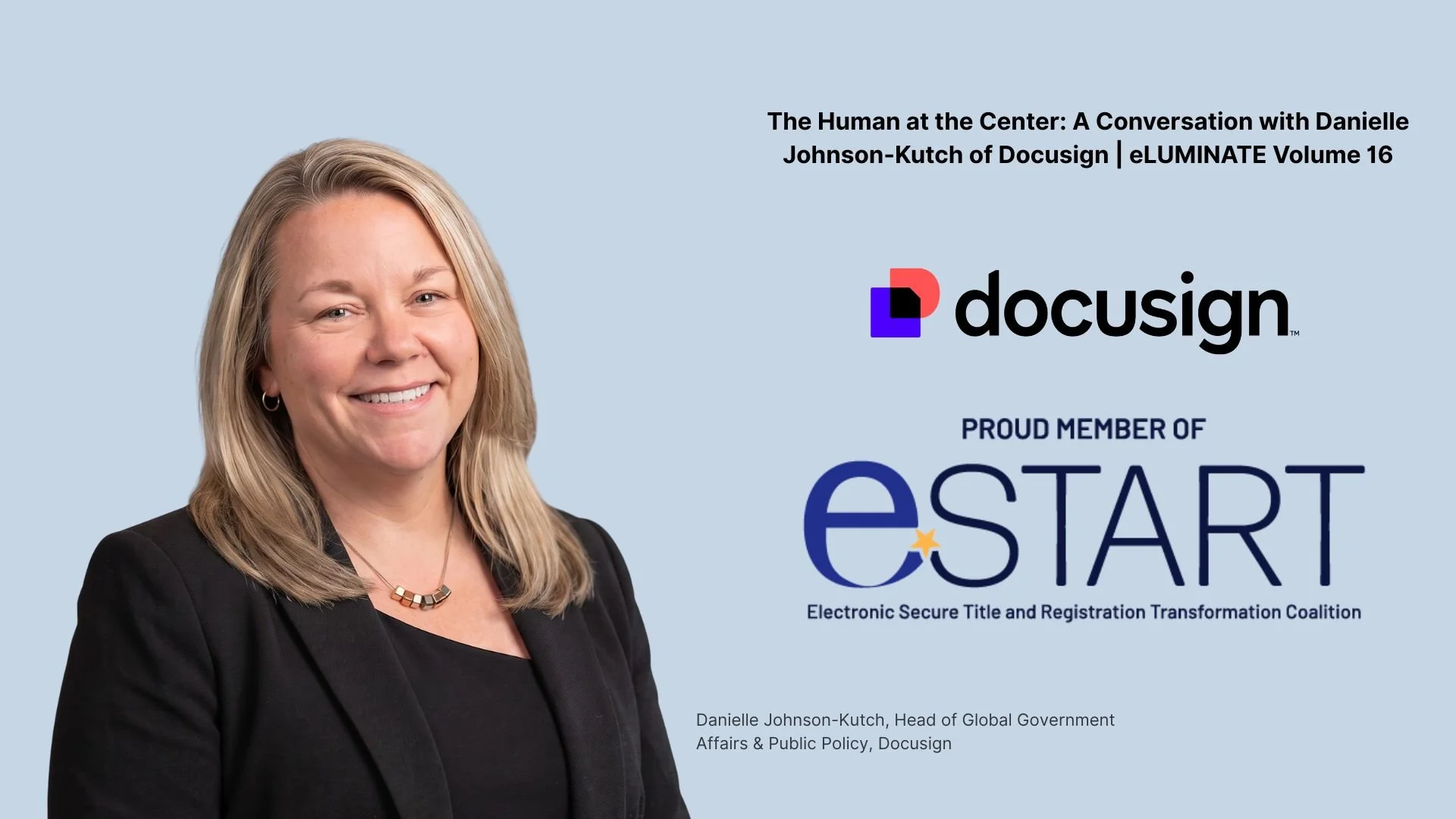
For this edition of eLUMINATE: An eSTART Coalition Profile Series, we sat down with Danielle Johnson-Kutch, head of global government affairs at Docusign and chair of the board of the Electronic Signature and Records Association (ESRA). Danielle's career spans high-stakes federal policy and private-sector technology, giving her a practical view of what it actually takes to move government processes off paper. In this conversation, she reflects on the human at the center of title and registration, why trust and change management matter as much as the technology itself, and what she hopes will come out of the eSTART Modernization Forum this October in Nashville, where ESRA and eSTART are convening the ecosystem in one room.
Let's start with introductions. Can you tell us about yourself, your role, and Docusign?
I'm the head of global government affairs at Docusign, where I work with policymakers and partners across the public and private sectors to modernize agreement processes. A lot of that work is with governments, on managing titles, registration, and other critical records.
Most people know Docusign as an e-signature company, but we've moved well beyond e-signatures. We now help organizations manage the full lifecycle of their agreements through Intelligent Agreement Management, or IAM, the platform we introduced a few years ago. It uses AI and advanced technology to make agreements smarter and more efficient, and the goal is to help organizations move from manual workflows to trusted digital experiences.
How did you get here? Walk us through your path to Docusign.
My work at Docusign is really an evolution of my career. Before joining, I spent years in housing, financial services, and public policy, including time at the US Department of the Treasury. There I served as Director of the Office of Financial Stability and oversaw the Troubled Asset Relief Program, or TARP, managing large-scale economic stabilization efforts and complex regulatory challenges in a high-stakes, policy implementation environment.
That experience gave me a deep understanding of where financial policy, market dynamics, and governance intersect, and it maps directly onto what I do now. I use it to engage policymakers and build trust in digital transformation. It also shapes how I approach modernization, at a systemic level rather than one form at a time, and how I advocate for secure data frameworks and risk-based standards for the technology we put in front of agencies. What all of it taught me is that modernization is fundamentally about reducing friction and improving outcomes for people, whether those people are agency staff, lenders, or citizens.
What do you think is most often underappreciated about this work?
There's a human at the center of this process, and that can still get lost.
We've had a lot of initiatives at the federal and local levels around citizen experience, so I don't know that it's forgotten exactly, but it does get underappreciated. Whether it's the agency employee doing the work or the person walking into the DMV, we don't always account for how many steps, handoffs, and paper documents everyone is asked to manage, and how much time and cost that adds for the DMVs, dealers, lenders, and consumers alike.
As technology-driven solutions emerge, efficiency becomes the buzzword, and it's easy to focus only on speed and automation. But we have to hold onto accessibility, transparency, and clear communication, so people actually understand and trust that a digital workflow serves them better than a wet signature or a decentralized paper process. That's true at the citizen level and at the government level.
From the Docusign vantage point, what's the biggest barrier to modernizing title and registration?
The biggest barrier is the complexity and fragmentation of the existing processes. Different forms, different rules, different stakeholders across jurisdictions, and all of it needs to be harmonized.
That fragmentation feeds a second barrier, which is trust. Agencies and consumers want assurance that digital systems are secure, resilient, and will keep working reliably over time, especially for records as important as vehicle titles. And then there's change management. Modernizing title and registration isn't just a technology project. It takes training, updated policies at the state and local levels and possibly the federal level, and real collaboration across the agencies and industry partners who serve these customers.
You also chair the board of ESRA, the Electronic Signature and Records Association. Tell us about that role, and how Docusign came into ESRA and eSTART.
I serve as chair of the board for ESRA, where I help shape the organization's strategic direction. We think of ESRA as the industry glue for digital transactions. The board is focused on convening a diverse group of stakeholders: tech innovators, legal experts, and everyday practitioners, and turning that expertise into clear, actionable advocacy for a trusted digital economy.
Docusign has been a member of ESRA and held a board seat for years, well before I arrived almost five years ago. Through that group, and our work there on remote online notarization and e-titling, we were introduced to the eSTART Coalition and came on as a founding member a couple of years ago. What excited us was the chance to bring this diverse set of stakeholders together around a process that is so ripe to simplify: a secure, end-to-end workflow for vehicle title and registration, digital odometer readings, and the rest, that works better for citizens while giving the agencies administering it stronger compliance and fraud deterrence built into the workflow.
ESRA and eSTART are co-locating the eSTART Modernization Forum in Nashville this October. What are you hoping comes out of it?
I'm excited about it. We were meeting as an ESRA working group recently, and someone pointed out that the E-Sign Act is 26 years old now. You would think that by this point a digital workflow would just be how things are done, that obtaining a government service would feel the same as the experience you get from your financial institution. But that's not the case yet. There are still a lot of barriers in the way.
That's exactly why this forum matters. Getting all of these stakeholders in one room, government, industry, associations, and operators, is how you start to hash out the important details and the next steps. We don't want to just keep talking about modernization. We want to take some action and actually deliver what customers expect from the process. We're proud to be partnering between ESRA and eSTART on it, and we're looking forward to the outcomes.
Any final thoughts for readers?
At Docusign, we think about title and registration as part of a broader journey toward intelligent agreement management, modernizing the workflows that let governments and businesses prepare, sign, and manage their agreements with confidence. For us, modernization is successful when it reduces friction for the frontline staff at the agencies, not just the citizens they serve.
Picture a world with fewer trips and shorter DMV lines, less manual rekeying of data for agency staff, and clear visibility into exactly where your title or registration sits in the process. That's the world we envision, and we're excited to bring it forward. Once we modernize these core processes and make them secure, it really opens the door to so many other seamless experiences, in transportation and mobility especially, but well beyond it too.
