
Getting Past the Fear of Change | A Conversation with Jessi White of the Iowa Automobile Dealers Association
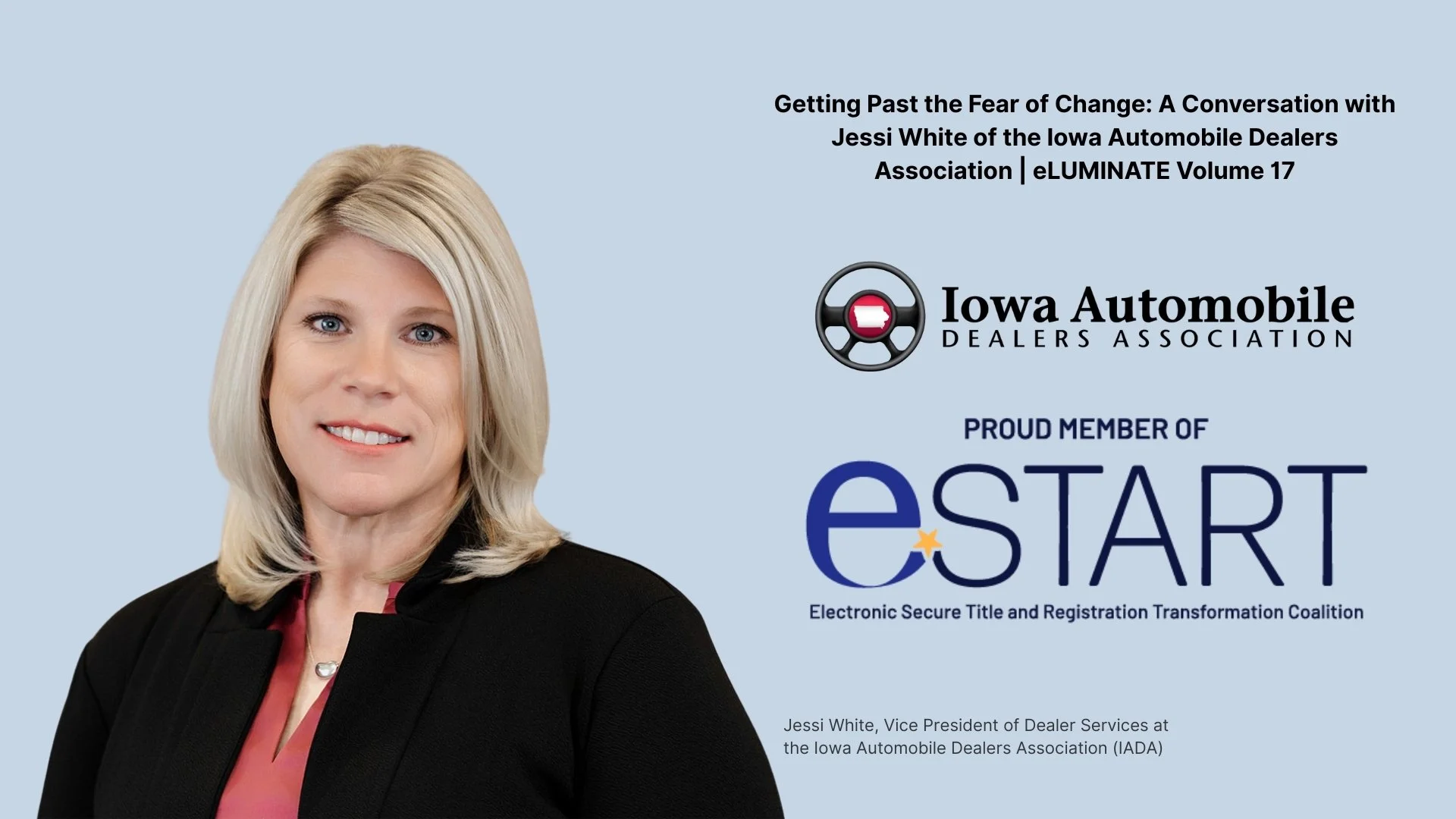
For this edition of eLUMINATE: An eSTART Coalition Profile Series, we sat down with Jessi White, vice president of dealer services at the Iowa Automobile Dealers Association (IADA). Jessi has spent more than twenty years at the association, and she has led the rollout and ongoing support of the state's electronic registration and titling (ERT) system since it launched in 2018. In this conversation, she talks about the barrier that gets discussed least in modernization work, the fear of change, why buy-in matters as much as the technology, and why the surest path forward is small bites rather than the whole apple.
Let's start with introductions. Tell us about yourself, your role, and IADA.
I'm the vice president of dealer services with the Iowa Automobile Dealers Association. IADA is a trade association representing franchised new car and truck dealers in Iowa, and we're a best practice organization, so we provide the resources that help dealerships comply with the complex rules and regulations of automotive retailing, along with services like educational webinars, forms, and supplies.
My role centers on supporting dealerships through Iowa's electronic registration and titling program, which we call ERT. I provide the training, guidance, and ongoing support that helps dealers move through the title and registration process efficiently, and I work closely with the Iowa DOT to improve the system for both dealerships and counties. I also lead compliance-focused meetings so our members stay current on regulatory changes, and I collaborate regularly with the Iowa counties, all 99 of which process title and registration, along with the Iowa DOT, the Iowa Department of Revenue, and the Iowa County Treasurers Executive Board. At the core of it, my job is to streamline processes, foster consistency across the state, and bridge communication between all of those stakeholders.
Tell us about your career and how you got into the association side of the industry.
I came to IADA in 2006. I started in our services department, providing products to dealerships, everything from title and registration forms to supplies and promotional items, which touched every department from finance to parts to collision. That's really how I learned how a dealership operates. When Iowa launched ERT in 2018, I was brought on as director of dealer services to help dealerships sign up, and I grew into providing the training and support for the system. I've since been promoted to vice president. The role now covers just about anything dealers need, but compliance, and especially ERT, has kind of been my baby.
How did ERT become a focus for IADA? Was there a specific member problem behind it?
It came from our board. Our members needed a system that would let them work more efficiently, because for dealerships, perfecting the lien is the ultimate goal. Lawmakers had everyone come together for a study — the DOT, the counties, dealers, lenders, and auctions, all the partners — to define what the system should look like. The conclusion was clear. We needed electronic lien and title, and we needed electronic registration and titling. The code had to change so the DOT could build it, and because our dealers were out front asking for lien perfection, we took the lead with the DOT to make it happen.
How did you first hear about eSTART, and why did IADA get involved?
Our involvement started right away, back in March of 2024. When the email came through, we signed up, because we understood the vision and the space eSTART was creating for people to collaborate. Not everyone attends the same conferences. Lenders go to one, auctions to another. Having a community where we could all have those conversations together was something we valued.
What's the biggest barrier you run into day to day in title and registration modernization?
Honestly, it's one that's so obvious we don't really talk about it. It's the fear of change. We're asking people to change processes they've done for years, and some clam up. They've heard the horror stories, they don't want to be first, and they know a new system comes with bugs at the start. But to reach the end goal of modernization, we have to change, and getting people to trust that it will be a better system is the hardest part. Once one person buys in and can actually see it, because people need to touch, feel, and see things, they start to grasp the benefit. Then the challenge is shifting everyone else.
The best example is our own ERT launch in 2018. We have 99 counties processing title and registration for everyone in the state, and when ERT was first talked about, they were very apprehensive. There was a lot of concern about losing jobs and efficiencies, and some were still telling dealers to just keep sending things in on paper. Now, here in 2026, they absolutely love it and wish every deal came in through ERT, because it's faster, more secure, and easier. They'll say to me, isn't it funny how we did a complete turnaround on this?
It was the same with the title clerks. So many were used to paper, writing out the check and putting on the stamp, that the new process felt overwhelming and they were sure they wouldn't like it. I'd tell them, give it three months and you won't remember how you did it before. And I've had so many come back and say, I didn't believe you, but I'll never go back. That hurdle, and the fear of change behind it, is the biggest barrier I see.
Is there anything specific you want to highlight?
One gets missed a lot: Some jurisdictions try to eat the whole apple instead of taking small bites. They see where other states are, feel they have to catch up all at once, and it becomes too big to get through, so it stalls. In Iowa, we take baby steps. We make adjustments and learn along the way, and even when it feels painfully slow, working through it with the Iowa DOT and our partners means we build the system the right way rather than just building it and handing it over.
The other thing is that people sometimes view dealer associations as a roadblock, or one more layer in the process. That's the furthest thing from our intention. Our value is in addressing the needs of our dealers, and a big part of that is making sure title and registration goes smoothly, because it protects the customer's experience. A customer can love the car and the dealership, and then 30 days later something is hung up with their title and they have to come back in, and that sours everything. The role of the association is to address those needs and to be a voice in this community that helps move process improvement forward, alongside the jurisdictions and all the partners.
