
From Insurance to Innovation | A Conversation with John Yarbrough of PDP Group
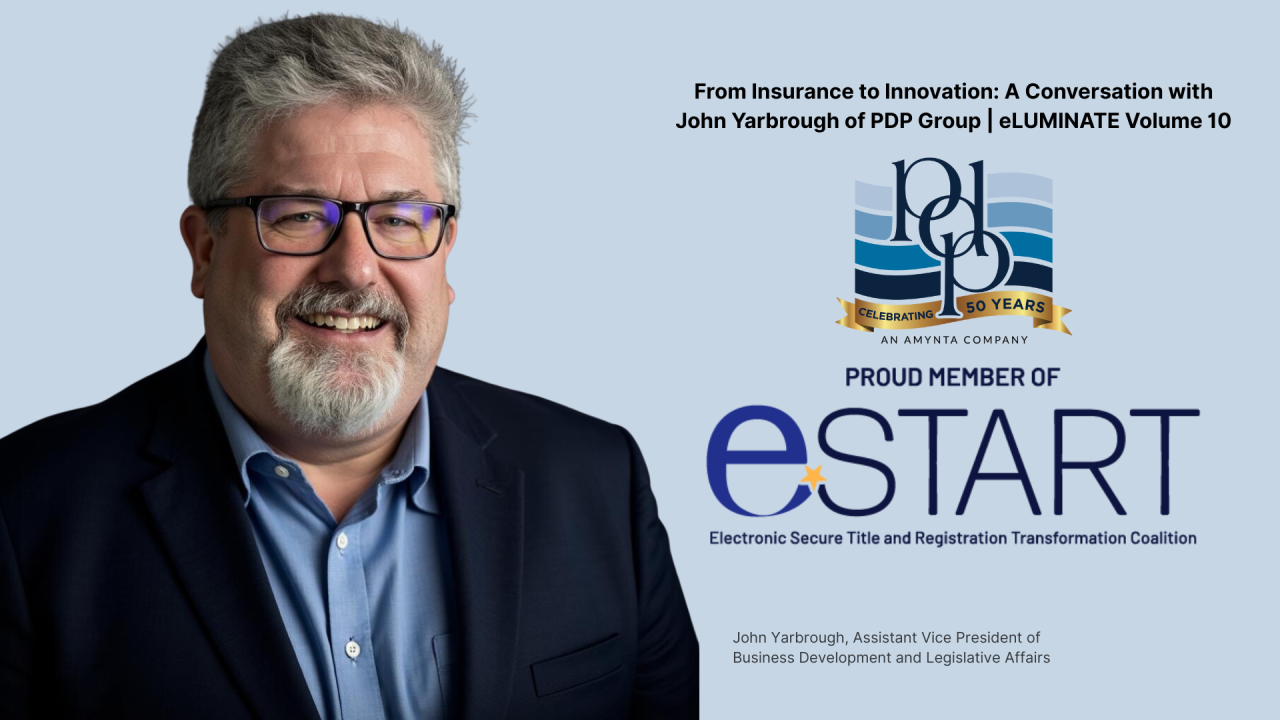
For part 10 of our eLUMINATE: An eSTART Coalition Profile Series, we spoke with John Yarbrough, Assistant Vice President of Business Development and Legislative Affairs at PDP Group, Inc. – a company with more than 50 years of experience bridging insurance, finance, and title administration for the auto industry.
In this conversation, John shares PDP’s evolution from an insurance brokerage to a key player in electronic lien and title services, his own journey through the automotive ecosystem, and why modernization must be built on trust, data accuracy, and shared purpose.
Let’s start with introductions. Tell us a little about yourself and your work.
I’m John Yarbrough, the Assistant Vice President for Business Development and Legislative Affairs for PDP Group. I’m responsible for sales and for government relations involving PDP Group.
What is PDP Group, and how did it get to where it is today?
PDP Group has been in business for 50 years. We started out as a commercial property and casualty insurance agency for auto dealers, and we still are. Since then, we’ve expanded into brokering floorplan insurance for lenders, OEM service and rental cars programs, and title administration for lenders.
At some point in the 90s, we were asked to do insurance tracking for a little company called GMAC. As GMAC evolved, we also assumed their paper title administration which was distributed across their nationwide branches. When electronic lien and title programs began in states like Idaho and Pennsylvania, we became increasingly involved in the digital side of title management.
How did you personally find your way to PDP Group?
I was on the board for the National Title Solutions Forum, which is part of the American Financial Services Association. At the time, I was representing my company, PAR North America, which was an affiliate of ADESA. So I had always been around the title world, even before PDP.
When PDP approached me, they were looking for someone who understood both the business development and the legislative side. I had already been involved with legislative work in Illinois, so it felt like a natural fit.
What’s PDP Group’s approach to electronic titling and modernization?
PDP is large enough to handle corporate compliance requirements, but small enough to be flexible and agile. We make sure what we build aligns with how states regulate lien and title activity. That’s been one of our core strengths – we’ve worked closely with DMVs for decades, so we understand their language and their expectations.
We see e-titling not as a one-size-fits-all technology, but as an ecosystem. Every state has different statutes, workflows, and levels of readiness. Our role is to make sure lenders and dealers can work within that system seamlessly, without creating more friction.
What’s important is accuracy and trust. When you’re holding someone’s title, or their lien information, that’s a legal document. It’s not something you can take lightly.
What are the biggest challenges you see in modernizing title and registration?
The biggest challenge is fragmentation. There are 51 jurisdictions, and every one of them has a slightly different process. Some are completely digital. Some are still entirely paper. Most are somewhere in between.
And then you have the industry side – dealers, lenders, insurers – all trying to keep up with different requirements. That’s where PDP tries to help: we act as the translator between what government needs and what industry can do.
How is PDP involved with eSTART and the broader modernization effort?
We’re participating in the eSTART coalition because it creates a space for alignment. We get to share our experience working with state DMVs and finance companies, and we get to hear how others are approaching digital transformation. That kind of collaboration doesn’t happen often enough.
For us, it’s not about being the loudest voice in the room. It’s about making sure the people who touch titles every day have a seat at the table while these new systems are being designed.
What’s something people often overlook when they think about titles?
People don’t always realize how many different industries rely on that piece of paper – or digital record now – to function properly. It affects insurance claims, loan originations, repossessions, fleet sales, state tax revenues… everything.
So when you digitize that process, you can’t just think about efficiency – you have to think about integrity. If the data is wrong or the workflow is incomplete, the whole system breaks down. That’s why our focus is always on accuracy and partnership.
Any final thoughts on the path forward?
We need to keep building momentum. The industry is ready for this, and so are most states. What we have to do now is work together to make sure digital titling is done the right way – securely, consistently, and with everyone in mind.
I think the next five years will define how the automotive and finance industries operate for the next fifty. And that’s what makes this work so exciting.
