
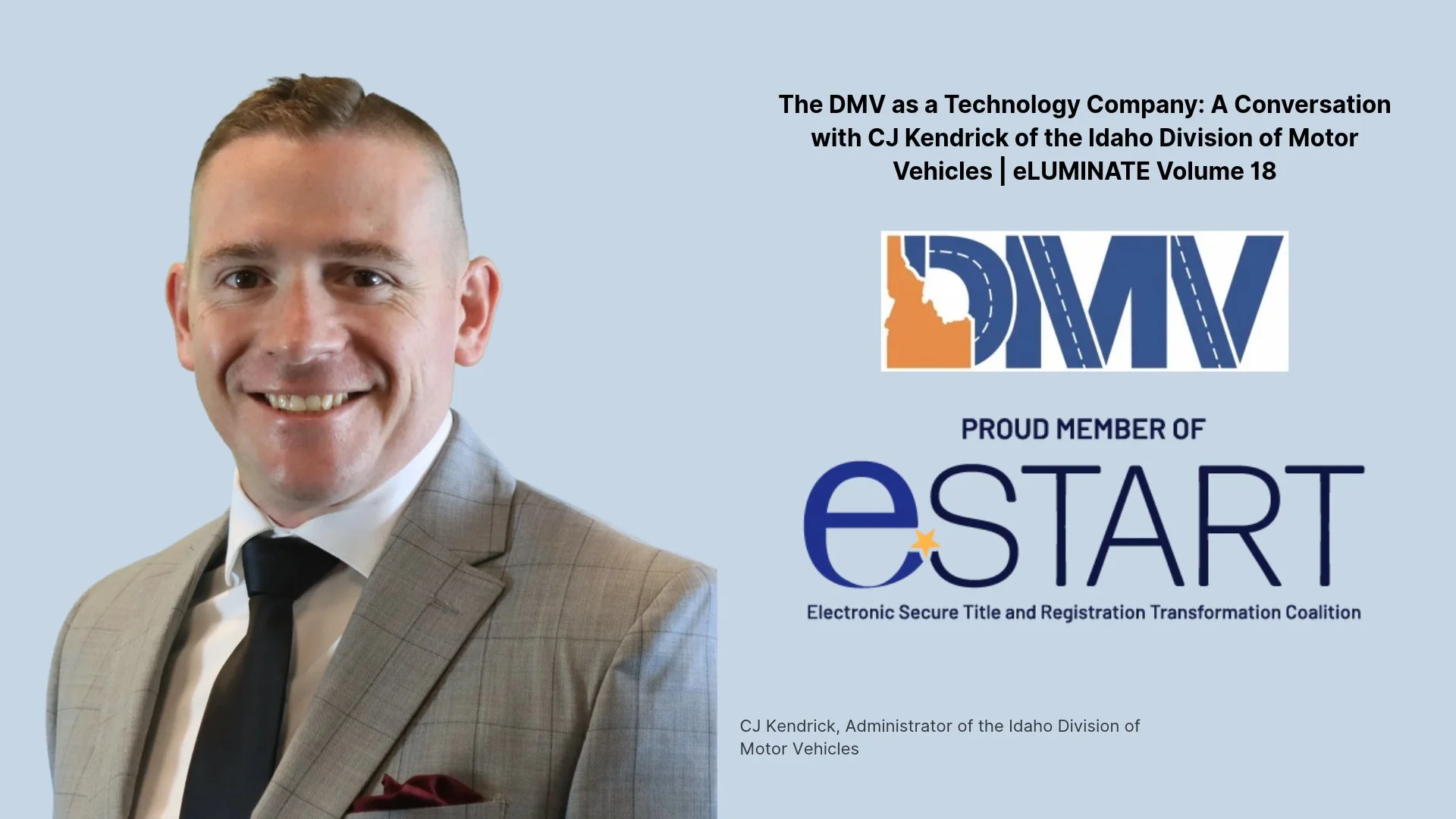
For this edition of eLUMINATE: An eSTART Coalition Profile Series, we sat down with CJ Kendrick, Administrator of the Idaho Division of Motor Vehicles. CJ began his career inspecting commercial trucks at an Idaho port of entry and spent 14 years moving through dealer licensing, motor vehicle investigations, title supervision, and vehicle services before being named administrator. He now oversees a division that runs a home-built system of record. Idaho’s “Skip the Trip” program logged 2.2 million online transactions in fiscal year 2026, in a state with just over 2 million residents. In this conversation, he talks about running the DMV like a technology company, why nothing in a modernization project gets to stay just because it already exists, and what other jurisdictions can take from Idaho’s experience.
Let’s start with introductions. Tell us about yourself, your role, and the Idaho DMV.
I’m CJ Kendrick, and I’m the DMV Administrator for the state of Idaho. While I oversee the DMV operations in Idaho, the real story is about the teams that make it happen. We have about 240 state employees working in both identity- and vehicle-related issuance. This includes operations, customer support, compliance, and technology, plus over 500 county agents who help customers complete in-person transactions through our local offices across the state.
Idaho’s setup is slightly unusual. Only a few states have vehicles and drivers under one umbrella, and our system of record for both operational areas was built and supported in-house and is based on the concept of one person, one record. Our on-prem system is based on Microsoft Dynamics CRM, with an internal development team of 25 to 30 people, so technology is closely tied to our day-to-day business. We are now developing a cloud-based solution, starting with commercial vehicle registrations. Then we will move on to non-commercial vehicles and driver services.
Tell us about your career and how you ended up leading the DMV.
I started in our Port of Entry program, inspecting commercial vehicles for weight and safety compliance. I was just out of the Army, where I was a flight medic on helicopters, and figured if I could preflight a helicopter, I could inspect a truck. That turned out to be a bit of an oversimplification. After a few years, I moved to headquarters as a dealer licensing agent. Dealers kept calling our dealership line with title questions, and instead of forwarding those calls to the title agents, I started learning the titling requirements myself.
That led to our Motor Vehicle Investigations team, where I became lead investigator for the state, and then as opportunities arose, I became the Titles supervisor, Vehicles manager, and Deputy Administrator. When my former boss, who is now Chief of Administration for the Idaho Transportation Department, moved into her new role in July, I was fortunate enough to step into the Administrator position.
What first sparked your interest in modernizing title and registration?
The discussion about why we were still relying on paper began around 2017, when I was working as an investigator with dealerships. At that time, I realized how archaic the process seemed. The stock market has been electronic for decades, so why are we still handling vehicle records on paper?
The pain points became clear when I moved into leadership roles on the Vehicles team, first as titles supervisor and then as vehicles manager. Some dealerships embrace technology, while others still rely on paper. As a public agency, we must meet constituents where they are and help them move forward with us. New residents presented another challenge. Someone moving to Idaho from California or another ELT state could have an electronic title printed, mailed to Idaho, submitted, and converted back into an electronic record. That never made sense to me. We were adding unnecessary paper steps to an otherwise digital process. When the industry wants a solution and the technology already exists, it is difficult to justify maintaining the old approach. Our philosophy is simple: Amazon is not a delivery company; it is a technology company that ensures the products you order arrive at your door. Likewise, the DMV should be a technology company that delivers DMV products—not simply a DMV that uses technology.
How did you first hear about eSTART, and why did it resonate?
I first learned of eSTART in February at the E-Titling Forum in Savannah, Georgia, hosted by AAMVA. Around the same time, our department was aware that legislation allowing a motor vehicle record in lieu of a title might be introduced in Idaho. This sparked several good conversations on the topic with Montana and our other neighboring states.
The topic is also closely aligned with what we’re incorporating into our commercial vehicle cloud development. One of our guiding principles is that we must build solutions alongside our industry partners and listen to the customers we serve. If we aren’t doing that, we’re doing ourselves and our customers a disservice. As I learned more about what eSTART is, I was glad to learn similar conversations were happening across the industry. There are solutions out there that we may not be thinking about, and sometimes a small shift in perspective is all it takes to let you solve a challenge in a new way.
Tell us about the “Skip the Trip” initiative and what you’ve learned from it.
“Skip the Trip” is our effort to give customers a convenient, electronic way to interact with the DMV. We want the program to be as successful as possible because it’s a more efficient and less expensive way to provide government services. If you’re required by law to interact with the government, it should be simple, convenient, and cost-effective.
The program really took off after our modernization efforts expanded what we can do online. We started with the customer portal, which gives citizens a personal account complete with a digital wallet and garage where they can view their vehicles and complete more than a dozen different transactions.
In the state’s fiscal year 2026 (July 2025 through June 2026), we reached 2.2 million “Skip the Trip” transactions, and our online transactions accounted for over 50 percent of all DMV transactions during multiple months of the year. We’ve had to move our goalposts because it has been so successful. Today the program returns approximately $7 million annually to Idaho’s economy through customer time and cost savings. Even that figure doesn’t account for wages people would have lost taking time off to go to an office.
One of the biggest lessons we’ve learned is that changing customer behavior is incredibly difficult. Instead of asking customers to learn an entirely new process, we've focused on making familiar processes digital. Often, success comes not from changing the workflow, but from removing the paper.
Our next step is a dealer portal launching in December that allows 100 percent electronic title submission. It generates the title application and allows dealers to use their own e-signature solutions. Dealers can then upload documents, pay for the transfer, and all communication between the dealership and the department happens online, including notifications if something is missing or when a title has been issued.
Each launch has reinforced the same lessons. Get industry involved early and listen to their feedback. Keep the process that users already understand whenever possible while making them digital. And heavily invest in training and testing with your own team. It isn’t enough to show people a new screen and consider them ready. Successful implementation takes a lot of collaboration, including bringing in partners you wouldn’t expect to be in the same room for the training.
What can other jurisdictions learn from Idaho’s experience?
There are no sacred cows. It’s human nature to build legacies and not want them touched. As we move our system to the cloud, our architecture meetings have a clear directive: every piece of functionality must earn its place. A feature doesn't belong in the new system simply because that’s how we do it now.
Even though our current system is modernized, not a mainframe overlay, we still carried forward processes and customizations that we don’t need. Those processes and customizations served no purpose other than mirroring old workflows.
That leads to an important question: does the process need to change or does the system? Is there a statutory requirement driving the process, or are we simply preserving tradition? Asking honest questions without ego is critical. There’s some risk in challenging longstanding practices, but the greater risk is building tomorrow’s technology around yesterday’s assumptions. We must view every process with the customer in mind instead of building a solution that matches what already exists.
Which aspects of title and registration modernization are most often overlooked?
One principle is making sure responsibility rests with the right organization. Our abandoned vehicle process is a good example. Law enforcement used to be responsible for notifying customers, which isn’t their job and pulls them away from law enforcement. We were fortunate to get statute changes that moved that responsibility to the department. Customer notifications are something the department does well and at scale. Today, we send nearly 150,000 notices for a variety of DMV services and transactions.
Another principle is balancing responsibility between government and industry. This is more of a personal philosophy. Dealers are already responsible for verifying a person’s identity and complying with federal finance and regulatory requirements. Rather than duplicating these efforts, we need to determine where we, as the DMV, fit in with that validation. The challenge is finding the right balance between the dealer's responsibilities and the DMV's responsibilities so transactions flow smoothly and industry partners are willing to adopt the solutions we build.
Another lesson is building on what works. Don’t reinvent the wheel just because you have the chance. When we develop roadmaps, we first look to see what we have already built, what’s working well and how we can leverage those investments to maintain our velocity. Even the conversations around eSTART are partly driven by the speed and convenience customers are demanding. We must be prepared to meet those expectations.
Finally, don’t build a machine more complicated than it needs to be, because people won’t use it. Customer behavior can change when the change is measured and incremental, but an overly complicated process will hurt adoption.
What else are you working on that has you excited?
We have a lot underway right now.
We’re training an AI tool for our personalized plate reviews. We are training it to check publicly available resources, including Urban Dictionary, and evaluate alternative interpretations of words and phrases to identify issues that might otherwise be missed. The goal is to improve consistency while reducing staff workload and the potential for human error. On the dealer industry side, our focus is on providing options. Dealerships can use authorized vendors for EVR/EVT services, but we’re also offering a home-built solution for independent dealers as part of the dealership license. We made that investment because the move toward e-title requires multiple digital titling solutions for all types of dealership models. We’re targeting 70 to 80 percent adoption within the next year, and it could put roughly $1 million back into the dealership industry annually, as there will be no additional administrative fees to use this method of submission.
We’re also developing a medical portal. While it primarily supports the driver’s license side, it also includes vehicle-related services such as disability placard requests. Through a portal, a doctor’s office or hospital group will sign in, order a placard, or update a person’s driving status, and that information will feed straight into our system in real time. If you have surgery, you could get a temporary placard in the mail as soon as the procedure is scheduled instead of going to the office. Ultimately, all of these initiatives are guided by the same principle: meet customers where they are, remove unnecessary steps, and use technology to make government services faster, simpler, and more convenient.
Any final thoughts for readers?
If you had told me 15 years ago that I’d be working for the DMV and that it would be this fun and this rewarding, I wouldn’t have believed you. It’s a great feeling to change how the DMV is perceived, and an exciting time to work with our industry partners and customers to solve problems. When you look at the volume of transactions moving through dealerships, lenders, auctions and floor plan industries, it’s amazing they operate as efficiently as they do with many of the processes still in place today. Idaho DMV provides an amazing service to our customers. There’s a lot to be proud of, but we can always do better. It’s an exciting time.
