
Locking In the Lien | A Conversation with Jack Chapman of Cardinal Gray
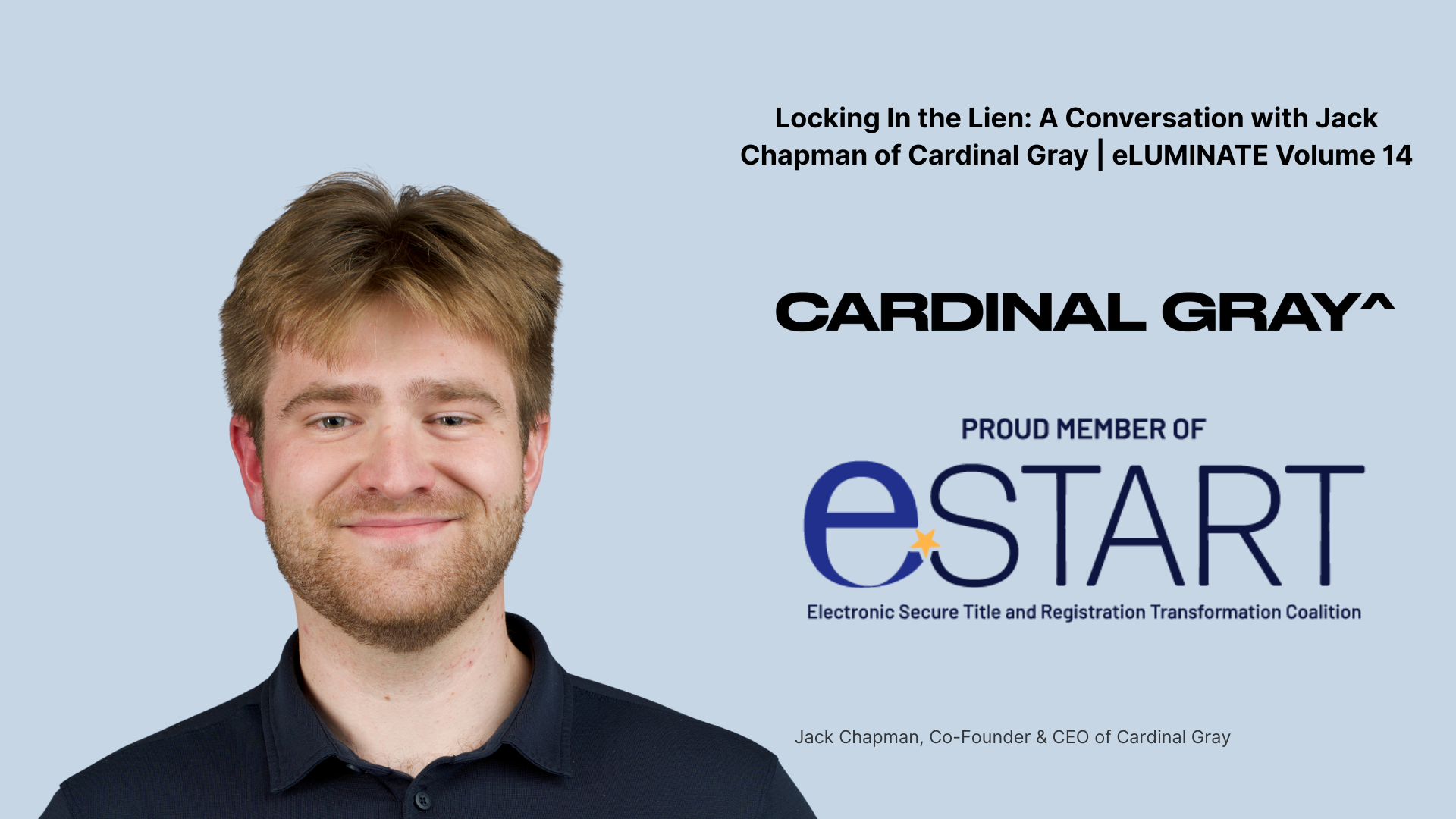
For this edition of eLUMINATE: An eSTART Coalition Profile Series, we spoke with Jack Chapman , Co-Founder and CEO of Cardinal Gray. A software engineer by background, Jack built Cardinal Gray around one of the most persistent friction points in direct auto lending: getting DMV documents generated, signed, and submitted without requiring borrowers to print, mail, or show up in person. In this conversation, he shares how a failed blockchain experiment led to a real solution, why dealers hold regulatory advantages that lenders don't, and what he'd change about vehicle data access tomorrow if he could.
Can you introduce yourself and tell us a little about Cardinal Gray?
I'm Jack Chapman, Co-Founder and CEO of Cardinal Gray. By background, I'm a software engineer, though in the early days of the company I was doing quite a bit of everything: writing code, filing DMV documents, placing liens. At this point I've transitioned mostly into sales, partnerships, and hiring.
Cardinal Gray builds software that automates the DMV forms required for direct auto lending and automates how lenders collect signatures on those documents. We work with lenders like One Main Financial and Capital One, using LLMs to extract information from driver's licenses, registration documents, titles, and origination systems, then populate the right DMV forms and facilitate a signature appointment. The core problem we're solving is what happens when a borrower isn't standing in a dealership with a pen. In a direct or digital lending context, whether that's a refinance or a secured personal loan, there's no dealer handling the title work on your behalf. Historically, lenders would email a PDF, include a FedEx label, and ask the borrower to print, sign, and ship it back. That process takes days and creates significant dropoff. We've seen conversion rates for accepted offers jump from 20% to 60% after lenders implement our solution.
We're a team of five right now, and we're processing about 30,000 loans a month.
Walk me through your path to starting Cardinal Gray. What was the lead-up?
My co-founders and I were at Stanford studying computer science when we took a class with the business school that sent us to Libya to build customs software for the State Department. We were taking an entirely paper-based process and connecting it to international digital databases. It was the kind of project that makes you realize how much friction exists in systems that could reasonably be automated, and we got hooked on that problem.
After we graduated in 2022, we were seeing title and registration challenges come out of COVID that seemed to impact organizations like Carvana disproportionately, given their scale: incredibly capable on the logistics side, able to ship a car across the country, but hitting walls when it came to updating the piece of paper that actually says who owns the vehicle. That got us interested in auto. We also had finance backgrounds, which led to what I'll just call a dumb idea: putting car loans on a blockchain. A few months into that experiment, sitting in a temporary Airbnb in New York, we realized it wasn't going to work. As we tried to salvage the concept, we kept running into the same wall, the DMV piece for direct lending. You can't perfect a lien without getting the right documents signed, and nobody had made that easy. So we prototyped software and started talking to lenders.
One of the conversations that shaped how we think about what we built was with someone at PenFed. They had originated a significant volume of refinance and private party loans during COVID when rates were low, and ended up with half a billion dollars of auto loans that were over a year old and had no lien placed on them. Essentially unsecured loans. He described what we were building as a front-end engine for lien perfection, and we still use that as our one-liner.
What do you see as the most overlooked issue in title and registration right now?
There are so many systems built specifically for dealers, and there's often very little functional reason why a lien holder or a lender couldn't access those same systems. Dealers have done a lot of state-by-state advocacy and have built real relationships with DMVs over time. But the result is that certain digital workflows are available to dealers that aren't available to anyone else.
Georgia is a good example. A dealership in Georgia can use e-sign on certain forms. A direct lender or a software company working with that lender cannot. We've even explored getting dealer licenses in specific states just to access tools that should reasonably be available to any party with a legitimate business purpose in the transaction. The ecosystem would benefit from those systems being more agnostic about who's on the other side of the filing.
Where do you see the biggest structural barrier to modernization more broadly?
Infrastructure. Most states have some version of a digital filing system, and the better ones, like Kansas, let you upload your documents and process without mailing anything in. We just need all states to have something like that. They're all going to be different, and that's fine. But a lot of these systems are from the eighties and nineties, and B2G software just takes years to get procured. Once something is in place it's going to be there for ten years regardless of whether it's working. I don't even mind if a system is old as long as it works. The bigger risk is getting something new in place that doesn't solve the right problem, and then you're stuck with that for a decade.
That's part of where eSTART fits in, I think. Making sure that when states do go to procure something new, they're not accidentally buying software that misses the mark.
How did you first encounter eSTART, and what brought you in?
Tony Hall's signature requirement maps. We were early in clearing a backlog of 200 loans for our first customer, Tenet Energy, and we had no idea what each state would and wouldn't accept for lien placements. We found Tony's Tableau maps online and used them to work through Texas and Florida first, knocking out about 40% of the backlog in the first month. That was the entry point.
We got more formally involved because of the states we couldn't crack on our own. We do a lot of work navigating around regulations, finding the right document combinations that let lenders use Docusign instead of wet signatures or notarization. But there's always a last 10 or 20% of states that just aren't going to move without coordinated pressure. That's where eSTART comes in. A rising tide lifts all boats, and it's exciting that there's a coalition organized around making that happen.
Any final thoughts you want to leave readers with?
Vehicle data should be cheaper and more accessible. Specifically, NMVTIS. It has title issue date, which makes it genuinely useful for all kinds of pre-transaction checks. If you're about to place a lien in Florida and the vehicle has actually been relocated to another state, NMVTIS could tell you that before you waste the filing. The Driver's Privacy Protection Act exists for good reasons, and I'm not arguing against the intent. But the legitimate business purpose provision is broad enough that it should be covering more of what companies in this space actually need. There's a lot of data sitting in these systems that would make DMV transactions faster and more accurate for everyone involved, and I think we're leaving that on the table.
